HOME

Intactivism News

October -      2009

(More recent items first)

Earlier items


IOL News
November 18, 2009

Another E Cape circumcision death

The Eastern Cape has recorded its second death of the summer circumcision season, the province's health department said on Wednesday.

The 19-year-old youth died on Wednesday morning at an illegal intiation school in the Butterworth area of Transkei, spokesman Sizwe Kupelo said.

The cause of death was not known yet.

The school had been closed down by health authorities.

Another 19-year-old died of dehydration in the same area earlier this month.

Kupelo said the department would send a team to the area to close down other illegal schools.

...


The Mirror (London)
November 17, 2009

Ritual [actually, non-therapeutic] circumcisions 'illegal'

Exclusive by Stephen Moyes (stephen.moyes@mirror.co.uk)

DOCTORS performing ritual circumcisions on children face financial ruin, disciplinary action and even jail.

A test-case being brought by a 20-year-old man circumcised as a baby could, if successful, open the floodgates to claimants.

The unnamed man is to sue a GP still practising in Greater London for physical and psychological damage.

He will argue that circumcision on a child without a medical requirement is mutilation.

His father took him to be circumcised shortly after birth in accordance with his own religious beliefs.

Now the father is mortified at the mental and physical state of his adult son, and is supporting the case.

The father has documents that prove which GP carried out the circumcision.

Performing surgery on a person without adequate consent constitutes battery in law, which can be prosecuted in the civil courts.

But given the lack of consent the surgery also constitutes an assault which can be prosecuted under criminal law - meaning a guilty verdict could lead to a prison term.

The test-case is being supported by a legal firm, leading urologist, child protection agency and circumcision awareness body The National Organisation of Restoring Men (Norm). [actually NORM-UK]

Norm spokesman David Smith said: "Surgery is defined as 'manual or instrumental treatment of injuries or disorders of the body'. If no injury or disorder is present, then it can't be surgery.

"Circumcision is a mutilation, which is defined as 'to injure, to make imperfect by the removal of a part'. It is shocking that the NHS is responsible for mutilating children.

"We support a man's right to choose a ritual circumcision for himself, but not for anyone else.

"Adult circumcision is a straight-foward operation which can be undertaken in under 30 minutes under local anaesthetic. There is no excuse for forcing it on children.

"There is growing belief by many people that the only way to make doctors put their scalpels down is to take legal action. This is not about money, it's about protecting the next generation."

Some doctors privately charge up to s350 [sic £350?] for 'forced circumcision' of a baby brought to them by their parents.

Legal action can only be brought when the child reaches 18. There is then a three-year legal window in which they can take action against the GP.

Circumcision is a surgical procedure that can be performed on men and women and is done for a variety of reasons, some of them cultural or religious.

The General Medical Council does not have a public position on the issue of ritual male circumcision on children who cannot give informed consent.

A spokeswoman said: "We do not have general authority to determine public policy on issues that arise within medical practice - these are matters for society as a whole to determine, through the parliamentary process."

Katy Swaine, legal director of Child Rights Alliance for England, told the Mirror: "The UN Committee on the Rights of the Child has made clear that female genital mutilation violates childrens rights and this position has been reflected in the banning of such procedures under UK legislation.

"The carrying out of circumcision procedures on young male children must also be examined in the context of childrens rights under the treaty - not least given the requirement for non-discrimination in the application of treaty rights.

"A body of medical opinion has for some time supported the view that most male circumcision procedures do not have a medical basis. As such, given the invasiveness of the procedure and the negative consequences suffered by some individuals, there is a strong argument that it should not be carried out without informed consent from the individual who is to undergo the procedure.

"It is only a matter of time before these issues are raised in the courts by those who have undergone the procedure as children and have suffered negative consequences. In the meantime it behoves the NHS, Department of Health, professional medical bodies and communities to examine this issue seriously, acknowledging and addressing its implications for childrens rights."

The individual bringing the test-case is collating evidence and financial and legal support and will launch it next year.

A solicitor close to the case said: "The action being brought against the doctor is more likely to lead to financial damage rather than prosecution, but it is complicated and nothing can be ruled out.

"Doctors performing 'forced circumcision' on a small minority of children are acting in defiance of general medical council and are effectively medical rebels.

"Most urologists will only perform a circumcision on someone who needs it, just like any form of amputation.

"This is not a straightforward case. Parents have the right to give consent but only when in the best interests of a child. I don't think any act involving cutting off half of a child's penis is in their best interests."


No ethical issues ...

Omaha World Herald
November 15, 2009

A solution on stem cells?

By Rick Ruggles

Scientists during the past three years have made quick progress toward creating cells that eventually could end the controversial research into human embryonic stem cells.

... Researchers are using mouse cells, rat cells and human cells of many sorts — skin, eye, fat, brain, liver and others — to find those that are the most effective to manipulate into embryonic-like stem cells.

... Opponents of embryonic stem cell research applaud the UNMC work on the new kinds of cells as a sign of the demise of human embryonic stem cell research there.

... Japanese researchers in 2006 discovered they could create human embryonic stem cell-like structures by placing certain genes into skin cells.

... Another of the 22 recent grant recipients is a Colorado State University microbiology professor, Dr. Jeffrey Wilusz, who is working with foreskin cells from infant penises. He obtains the tissue from tissue banks. “Essentially, any human cell is fair game. Any mouse cell is fair game,” he said. “The frontier is limitless. ... The potential for iPS cells from a therapeutic perspective is limitless.” ...

(to the rest - if this link fails, contact us)

Contact the writer: 444-1123, rick.ruggles@owh.com


IOL News (South Africa)
November 12, 2009

Initiate's death blamed on dehydration

An initiate had died in Butterworth, in the Eastern Cape, apparently from dehydration, the police said on Thursday.

Captain Jackson Manatha said that 19-year-old Sonke Foca "is alleged to have dehydrated in his traditional hut on Wednesday".

"It is alleged that the deceased was circumcised by a professional traditional doctor (ingcibi) on Saturday," he said.

He added that a nurse had called an ambulance after she had noticed that he was very weak, but upon its arrival, Foca was already dead.

...


Today, msnbc.com
November 9, 2009

New debate on circumcision decision

A 3'01" discussion of circumcision that is only slightly biased towards it.

Reporter Tom Costello states unambiguously that most countries do not circumcise baby boys. Joel Stein makes it clear there was no way he would have chosen circumcision for his son if the family were not Jewish. "It's only the Jews and Muslims -- and Americans -- that do this, and everyone else is keeping it real." (Nobody ever wonders why the US is now alone in the developed world in doing this, and the claim that it's because US health care is better rings increasingly hollow.)

Doug Diekema of the AAP sounds neutral. He trots out the UTI and penile cancer arguments, but more weakly than in the past, and mentions risks but not harm.

Actual opposition to circumcision gets 18" of the the 3'01" (10%), in the form of a brief quote from Georgeanne Chapin.

Both female anchors of the show, Meredith Vieira and Ann Curry, admit that they had their sons circumcised. The younger, Curry, said she insisted on being there with her son through the procedure, that it was "so hard on him", and that the decision whether to circumcise was very tough. Vieira looks baffled (You mean it's a choice? And it hurts? "I wasn't there for the actual 'nipping' or whatever you want to call it") but says she thought a big reason parents choose it is that "dads want their son to look the way they look, so the son can identify with the father." Then it is Curry's turn to look skeptical, and say that's "not a good enough reason".


Vos Iz Neias? (New York)
November 9, 2009

Jerusalem - Mohel Sentenced to Community Service for Botched Bris

Jerusalem - The birth of a son to a young couple from Israel’s Central Region turned into a string of nightmares when the mohel who performed the bris made a poor incision, causing severe injuries. As a result of the slip the infant had to undergo some ten operations and still requires further treatments.

During the bris the mohel bandaged the organ too tightly, causing excessive pressure. The infant cried all night and the next day. The worried parents called the mohel, who said he would come the next day, but did not arrive. The parents took the baby to the hospital, where doctors discovered how serious the damage was.

The Rishon Letzion Magistrate’s Court recently sentenced the mohel to six months’ community service and a fine of NIS 10,000 ($2,650).

“I would have been happy had the outcome been different. The money is not important and obviously this amount does not even cover the medications. But in my opinion they should have given him a jail sentence,” said the baby’s mother.


That's three small steps for cats ...

LA Times
November 7, 2009

California cities act to ban cat declawing

L.A. is among those rushing to prohibit the practice before a state law backed by a group of vets says they can't.

By Maria L. La Ganga and Anne Colby

Reporting from San Francisco and Beverly Hills - The law of unintended consequences has seldom been more clearly illustrated than by the catfight unfolding from San Francisco to Los Angeles.

Veterinarians who did not want cities meddling in their business persuaded the state Legislature to bar local governments from banning the practice of declawing cats -- beginning in 2010.

Not wanting to be pushed around themselves, nearly half a dozen cities are rushing to prohibit the controversial procedure before the January deadline, striking a blow for rights both animal and municipal.

This week alone, the score was Cities 3, Vets 0.

The Los Angeles City Council voted 11 to 0 on Friday to ban declawing. Beverly Hills voted 5 to 0 on Thursday, and the San Francisco Board of Supervisors voted 9 to 2 on Tuesday. The cities must finalize their votes in coming weeks. ...


BBC News
October 26, 2009

Circumcision 'left boys in agony'

A doctor offering £150 [$US230] circumcisions at his private clinic in Essex left young boys in agonising pain, a disciplinary panel has heard.

Dr Aziz Chaudry allegedly did not adequately ensure young boys were fully anaesthetised, The General Medical Council (GMC) was told.

He is also accused of not fully informing the families of the processes involved at his clinic in Clacton.

Dr Chaudry admits failures over notekeeping but denies misconduct.

The hearing was told young boys were restrained in pain.

One boy's family was told he may need plastic surgery to correct damage, the GMC's Fitness to Practise Panel was told. Another boy, aged four, was taken to hospital after the operation.

Complaints from families
After one of the operations on a four-year-old in 2006, Dr Chaudry cleared a blood clot from the boy without washing his hands or wearing gloves, it was claimed.

The allegations against the doctor, who claimed to have more than 20 years' experience, were made after complaints from the Muslim families of five boys.

Dr Chaudry allowed two of the patients to leave hospital "when it was inappropriate to do so", the hearing was told.

A mother of three brothers to undergo surgery was told "words to the effect of there were no risks involved...", counsel for the GMC Nimi Bruce said. Yet days afterwards, the woman's 22-month-old was taken to hospital with an infection.

The hearing was told Dr Chaudry was "very dismissive" about the turn of events.

Another child, seven-year-old "Patient E" started to yell with pain in the days after surgery and had a three-day stay in Colchester Hospital.

The hearing continues.


Washington Post
Oct 19, 2009

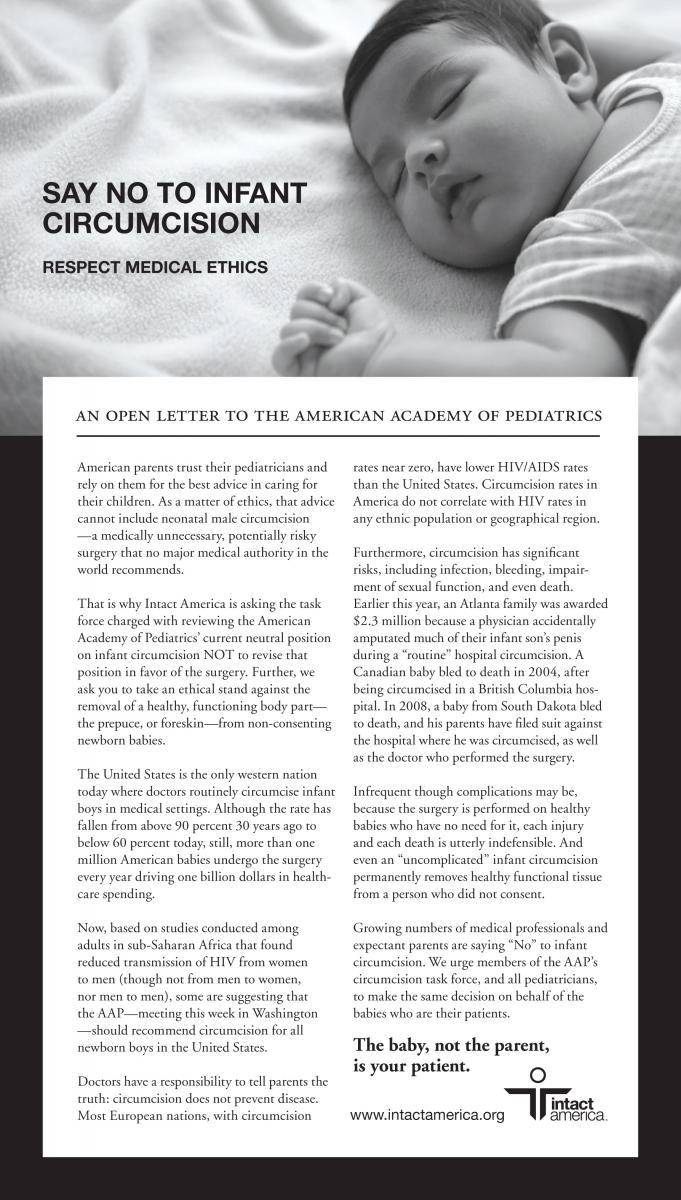
Intact America's open letter to the Washington Post

image

text:

SAY NO TO INFANT CIRCUMCISION
RESPECT MEDICAL ETHICS

AN OPEN LETTER TO THE AMERICAN ACADEMY OF PEDIATRICS

American parents trust their pediatricians and rely on them for the best advice in caring for their children. As a matter of ethics, that advice cannot include neonatal male circumcision-a medically unnecessary, potentially risky surgery that no major medical authority in the world recommends.

That is why Intact America is asking the task force charged with reviewing the American Academy of Pediatrics' current neutral position on infant circumcision NOT to revise that position in favor of the surgery. Further, we ask you to take an ethical stand against the removal of a healthy, functioning body part- the prepuce, or foreskin-from non-consenting newborn babies.

The United States is the only western nation today where doctors routinely circumcise infant boys in medical settings. Although the rate has fallen from above 9O percent 30 years ago to below 60 percent today, still, more than one million American babies undergo the surgery every year driving one billion dollars in health-care spending.

Now, based on studies conducted among adults in sub-Saharan Africa that found reduced transmission of HIV from women to men (though not from men to women, nor men to men), some are suggesting that the AAP-meeting this week in Washington-should recommend circumcision for all newborn hoys in the United States.

Doctors have a responsibility to tell parents the truth: circumcision does not prevent disease. Most European nations, with circumcision rates near zero, have lower HIV/AIDS rates than the United States. Circumcision rates in America do not correlate with HIV rates in any ethnic population or geographical region.

Furthermore, circumcision has significant risks, including infection, bleeding, impairment of sexual function, and even death. Earlier this year, an Atlanta family was awarded $2.3 million because a physician accidentally amputated much of their infant son's penis during a "routine" hospital circumcision. A Canadian baby bled to death in 2004, after being circumcised in a British Columbia hospital. In 2008, a baby from South Dakota bled to death, and his parents have filed suit against the hospital where he was circumcised, as well as the doctor who performed the surgery.

Infrequent though complications may be, because the surgery is performed on healthy babies who have no need for it, each injury and each death is utterly indefensible. And even an "uncomplicated" infant circumcision permanently removes healthy functional tissue from a person who did not consent.

Growing numbers of medical professionals and expectant parents are saying "No" to infant circumcision. We urge members of the AAP's circumcision task force, and all pediatricians, to make the same decision on behalf of the babies who are their patients.

The baby, not the parent, is your patient.

intact america www.intactamerica.org

[... and there is nothing the matter with him.]


Press-Enterprise (Riverside, CA)
October 18, 2009

DA refiles charges for Calif. dad who tattooed son

FRESNO

A prosecutor has refiled charges of aggravated mayhem against two men accused of tattooing a gang sign on a 7-year-old boy, raising the possibility again that they could face life in prison if convicted.

The Fresno County district attorney's filing Friday came two weeks after a judge ruled that Enrique Gonzalez and Travis Gorman should face the lesser charge of cruel and inhumane treatment of a child, rather than aggravated mayhem, a charge usually associated with disfiguring beatings, shootings and stabbings.

Prosecutors say Gonzalez, 27, held his son down

...

Attorneys for Gonzalez and Gorman say the prosecutor is overreaching. In making her decision earlier this month, Fresno County Superior Court Judge Hillary Chittick questioned whether a small tattoo is a permanent and painful disfigurement worthy of a potential life sentence.

"The DA's going to ignore the courts and proceed to a public lynching," said attorney Manuel Nieto, who is representing Gorman.

...

The prosecutor's motion requires attorneys for the men to show why Chittick was right to dismiss the charge of aggravated mayhem. No new evidence will be introduced.

Earlier story


The Sowetan (Johannesberg)
16 October, 2009

Court ruling brings relief

Sowetan says:

IT MAY have come too late for many youths who were kidnapped and forcibly circumcised but this week’s landmark ruling on circumcision should hopefully change all that.

On Tuesday Bhisho high court judge Yusuf Ebrahim ruled that circumcision without consent was illegal and went against an individual’s constitutional rights.

This follows an action by a young Eastern Cape man who took his father to court after he was forcibly circumcised despite his refusal on the grounds that he had already done so in hospital and that it was against his Christian beliefs.

The ruling holds out far- reaching implications for many communities since it asserts individual rights as enshrined in the Constitution .

That the judge ruled that circumcision without consent is illegal creates a conundrum for the communities who observe this rite since candidates earmarked for it are expected to comply without a murmur of protest.

Most significant is that the ruling interferes with the authority of the custodians of the tradition, such as chiefs, headmen and even parents who arbitrarily decide when and how their sons should be drafted for this rite of passage.

Surprisingly traditional leaders in Eastern Cape have already embraced the judgment, saying they respect each adult’s right of choice. Really?

Our surprise stems from the fact that though this proud tradition has often been marred by kidnappings of youths, traditional leaders have not been known to denounce forced circumcision – just as long as the initiates were drafted to a legal initiation school.

We therefore welcome both the ruling and traditional leaders’ response to it.

Earlier story


Vancouver Sun
October 14, 2009

Man found guilty of negligence in son's home circumcision

By Richard J. Dalton Jr.

A Metro Vancouver man who circumcised his four-year-old son at home with a razor blade and used blood coagulant meant for horses has been found guilty of negligence causing bodily harm.

The man, identified in a court ruling on Wednesday as DJW, admitted that in 2007 he circumcised his son, DJ, who was born at 2.5 pounds and couldn't be circumcised at birth.

The man performed the circumcision just a few years after he circumcised himself.

After he did that, his foreskin bled in nine places, doctors sutured it at hospital and his penis became infected. DJW's lawyer, Doug Christie, said, "He learned from that experience to do things differently."

Justice Marion Allan of the Supreme Court of British Columbia in Vancouver ruled Wednesday that the negligence charge was warranted but acquitted DJW on charges of aggravated assault and assault with a weapon. [The judge, inexplicably, ruled that the man did not seriously harm the boy and the razor blade was not used as a weapon. If it had been anywhere else but his foreskin ...] Social workers who found out about the circumcision a day after the procedure reported the incident to child-protection services.

Christie said DJ and his sister live with their mother, and DJW is banned from seeing them. DJW initially claimed a circumcision performed with reasonable care would fall under a religious exemption, Christie said. But he dropped the argument based on the judge's ruling.

"Although we don't agree, the judge found it wasn't with reasonable care," Christie said. Christie said DJW is considering an appeal.

DJW is a former Jehovah's Witness who now follows the Old and New TestaMents of the Bible. Here’s what happened, according to a summary of the case in the judge’s ruling: DJW became interested in circumcision after reading the books of Richard Hoskins, who advocates circumcision and claims there are Biblical answers to "all of the problems in society, including the number of abortions and homosexuals, and the national debt," judge wrote.

After DJ's birth, DJW heard a radio show on circumcision, transcribed it and decided to circumcise himself. On the Internet, he found "horrible pictures of what could go wrong," which is "inconsistent with his frequently expressed opinion that circumcision is an obvious and simple procedure," the judge noted.

In late 2004 or early 2005, DJW circumcised himself, using a razor, Band-Aids, peroxide, a roll of gauze and a clear plastic ring that he believed would act as an anaesthetic.

After he cut himself, the bleeding wouldn't stop. DJW then called his mother to tell her he was a heretic and would never go back to her church. She told him to call 911 and hung up. He then called 911 and went to the emergency room of a hospital and was sutured. In 2006, DJW began asking doctors about the circumcision of DJ. A few doctors advised against circumcising a four-year-old boy and refused to help DJW.

One doctor that agreed to do it was too expensive, charging $2,000 to $5,000. DJW decided to do it himself. He bought a blood coagulant used for horses because it was cheaper than a $30 coagulant for people. He told DJ that circumcision might hurt a bit but not for long. DJW told his son the procedure would grant him "extra special protection from God" and allow him to eat Passover lamb, ice cream and pick all the movies he wanted for a week. He also said told DJ it would be difficult to stay together as a family if DJ didn't agree to be circumcised.

DJW then gave DJ a teacup of homemade honey wine with eight to 12 percent alcohol. DJW then became stressed before performing the circumcision, so he left his son at home with his wife and went to Canadian Tire and Home Depot to "look at hardware and relax." When he came home, he laid DJ on clean garbage bags on the kitchen floor and put a towel or diaper under him, then cut the foreskin, sometimes with a sawing motion.

DJ shuddered and cried, and DJW's hand slipped. He told DJ to be still for a second cut. He used paper towels and a veterinary blood coagulant meant for horses, and the bleeding decreased. DJ then had to go to Children's Hospital.

A "beehive coating" of ash was removed from his penis and he was [" ]properly[" ] circumcised by Dr. Afshar.

In court, Afshar called into question DJW's procedure. Among numerous problems: The blades DJW used were neither sharp nor sterile. He said a kitchen cutting board under the boy's penis could have been covered with bacteria from food. And he said the veterinary coagulant was inappropriate and could have led to bleeding, infection and necrosis. Afshar testified that BC law doesn't ban people who have no medical training from performing circumcisions.

To view the court documents click here. [Recommended.]


Dispatch (South Africa)
October 14, 2009

Chiefs apologise to forced initiate

TRADITIONAL leaders have apologised to a teenager forced to undergo traditional circumcision after he took the matter to court, where it was ruled unconstitutional yesterday.

Bhisho High Court judge Yusuf Ebrahim ruled that circumcision without consent was illegal and went against an individual’s constitutional rights.

He made the ruling during the unprecedented court battle between a father and his son.

The son claimed to have been been forced to undergo traditional circumcision against his religious beliefs.

Bonani Yamani, a second year microbiology student at the University of the Free State, was forcefully circumcised after he was abducted by his father Lindile Yamani and 10 other men at his KwaMasele village near King William’s Town on March 3, 2007 .

This was three months after he had returned from East London’s Frere Hospital, where he had been surgically circumcised in November 2006 .

Yamani refused to go with the men, telling them that he had already been circumcised, but the men mocked the circumcision and took him to the bush were they circumcised him again.

Yesterday Ebrahim said that forced circumcision was against the Constitution and it was unfair for anyone to be discriminated against based on their religious beliefs.

Following an apology from Eastern Cape Contralesa, Yamani gave his consent for a settlement and withdrew his complaint .

The chairperson of Eastern Cape Contralesa, Nkosi Ngubo Mgcotyelwa, apologised to Yamani for remarks made by his predecessor, Chief Mwelo Nonkonyana, that people such as Yamani, who refused traditional circumcision, should be ostracised by the community.

Earlier story


Whatever happened to "It's only a tiny flap!"?

Aidsmap
October 14, 2009

Larger foreskin size increases HIV infection risk

Michael Carter

Larger foreskin size is associated with an increased risk of becoming infected with HIV, investigators from the Rakai circumcision study report in the October edition of AIDS.

“Larger foreskin size is a risk factor for HIV acquisition in uncircumcised men”, comment the investigators.

Several African studies have shown that circumcised men have a lower risk of becoming infected with HIV than uncircumcised men. The Rakai study was one of these studies, and showed that men who underwent circumcision at the beginning of the study had a 48% lower risk of infection than men randomised to remain uncircumcised.

Investigators from the Rakai circumcision study hypothesised that the size of an individual's foreskin may be associated with an increased risk of HIV infection, due to the larger surface area containing cells vulnerable to HIV infection.

They therefore analysed men in the clinical trial who had previously taken part in a cohort study to see if they could find an association between the size of the foreskin measured at the time of circumcision and the risk of HIV acquisition in uncircumcised men prior to the removal of their foreskin.

They conducted the retrospective analysis in men who had intially been recruited to the Rakai community cohort study, tested for HIV at baseline and followed for a median of four years prior to enrolling in the clinical trial and undergoing medical circumcision.

A total of 965 men were included in the study. In the clinical trial they were randomised to be circumcised immediately or to have circumcision delayed for two years.

Foreskin area was measured in centimetres square (cm2) by multiplying the length of the foreskin by the width.

In addition, the foreskin surface areas were categorised into quartiles:

  • Lowest 25% in surface area (7 – 26.3 cm2).
  • 26-50% (26.4-35 cm2).
  • 51-75% (35.1-45.5 cm2).
  • Above 75% (45.6-99.8cm2).

There were 48 new HIV infections. The median foreskin area was larger in those who became in infected with HIV compared with those who did not (41.5 vs. 35 cm2).

Furthermore, the mean foreskin area was significantly higher among those who seroconverted than those who did not (43.3 vs. 36.8 cm2).

[The Rakai study was the only one of the three Random Clinical Tests to use the sleeve procedure, which takes more inner mucosa than the forceps-guided procedure - yet all three studies found about the same reduction in HIV.]

The investigators also noticed than men aged 24 and younger had smaller foreskin areas compared to both men in their late 20s and those in their 30s and 40s.

[That's curious and needs explaining: does the foreskin grow with age? Is foreskin size decreasing?]

HIV incidence was lowest amongst men with foreskin surface areas in the lowest quartile (0.8 per 100 person years), and incidence increased with foreskin surface area, being 2.48 per 100 person years amongst individuals in the upper quartile (p < 0.01 for the trend).

After adjustment for possible confounding factors, the investigators found that individuals with a foreskin area above 45.6 cm2 had a significantly increased risk of becoming infected with HIV compared to men with the smallest foreskin surface area (adjusted risk ratio, 2.37, 95% CI: 1.05-5.31, p = 0.04).

[Did the confounding factors include the fact that men with bigger foreskins would have bigger penises and hence more confidence and more sex - and more problems using condoms?]

Men aged 25 and older (p = 0.01), those with a lower level of education (p = 0.03), and Catholics (p = 0.01) also had a higher risk of HIV seroconversion.

[...indicating that the researchers failed to correct for condom use.]

“We found that the mean foreskin surface area among men who seroconverted to HIV was significantly larger than among men who remained uninfected, and that the risk of HIV acquisition was significantly increased among men with foreskins in the upper quartile of surface area compared with men in the lowest quartile of foreskin area”, write the authors.

They conclude, “a larger foreskin area was associated with an increased risk of HIV acquisition”, a finding which they suggest has implications for circumcision providers who “should avoid leaving excess residual foreskin tissue after circumcision.” Although this is a particular problem with the forceps-guided procedure used in the study, because it leaves a margin of mucosal skin of up to 1cm, the invetsigators also note that this remaining mucosal surface is still substantially smaller than that measured in the lowest-risk group in this study.

Reference: Kigozi G et al. Foreskin surface area and HIV acquisition in Rakai, Uganda (size matters). AIDS 23: 2209-13, 2009.

[This also opens up a busy and lucrative opportunity to re-circumcise men already "inadequately" circumcised by traditional means.

These pages are still investigating this study ...]


PRWeb
October 13, 2009

Pediatricians to be Picketed on Circumcision

Intactivists will be protesting what they believe to be an unethical and sexist practice - infant circumcision - at the American Academy of Pediatrics National Conference and Exhibition (AAP NCE, 2009), Washington Convention Center, Washington, DC, October 17-20.

Washington, DC ( PRWEB) October 14, 2009 -- Intactivists will be protesting what they believe to be an unethical and sexist practice-infant circumcision-at the American Academy of Pediatrics National Conference and Exhibition (AAP NCE, 2009), Washington Convention Center, Washington, DC, October 17-20.

This year's AAP convention theme is "Pediatric Heroes: Champions for Children.' Intactivist Dan Strandjord, Chicago, says, "Cutting off the end of a boy's penis is not what a medical "hero" should do. It is a "villainous" practice, there is no medical reason for it. A real super hero would have the courage to "put down their scalpel" and force other doctors to do the same."

Demonstrators will be carrying placards satirizing the conference's cartoon characters of pediatricians as flying super-heroes. It depicts a super-hero protecting a baby boy with the comment: "Real heroes don't cut babies."

Girls are protected from genital cutting, even a pinprick, by federal law, but boys have no protection.

Circumcision is a multi-million dollar income stream for doctors, a source of revenue that is almost doubled in order to repair poorly performed circumcisions.

No medical association in the world, including the AAP, recommends infant circumcision yet the barbaric practice continues.

Originally[medicalized] by doctors in the late 19th century to control masturbation, the practice has become [customary] without ever passing scientific review.

###


So now cows are better protected than boys ...

Seattle Times
October 12, 2009

Schwarzenegger says Calif. cows can keep tails

California cows are the first in the nation with the legal right to swat flies as nature intended now that Gov. Arnold Schwarzenegger has signed a bill banning the painful practice of tail docking that he once mocked as being a waste of legislators' time.

By TRACIE CONE
Associated Press Writer

FRESNO, Calif. —

California cows are the first in the nation with the legal right to swat flies as nature intended now that Gov. Arnold Schwarzenegger has signed a bill banning the painful practice of tail docking that he once mocked as being a waste of legislators' time.

...

The Humane Society of the United States has vowed to take the fight against tail docking to other large dairy states such as Wisconsin, Vermont and New York.

Dairy officials say the practice of cutting off cow tails to prevent them from slinging manure is practiced on fewer than 15 percent of the state's 1.5 million dairy cows. Docking is usually done without numbing, either with shears or with a tight band that stops the blood flow and causes the tail to die. [...precisely like a Plastibell™]

The governor may have been influenced to vote in favor of the farm-animal legislation by California voters, two-thirds of whom voted for Proposition 2 last November to give egg-laying chickens more space. The governor of Michigan signed similar legislation Monday.


The Times (South Africa)
October 7, 2009

Traditional leader sorry for violent circumcision

By Biénne Huisman

A traditional leader from the Eastern Cape has apologised to 21-year-old Bonani Yamani, who was violently circumcised two years ago.

In a drastic about turn, the chairperson of the Congress of Traditional Leaders of South Africa in the province, Nkosi Ngubo Mgcotyelwa, apologised for previous remarks by the congress that men who refuse traditional circumcision should be ostracised.

He also called for an end to forced circumcision.

In a settlement document filed at the Bhisho Equality Court on Monday, Mgcotyelwa said Contralesa accepted that "the Constitution of South Africa gives the right to each adult male individual to choose whether or not he should attend traditional circumcision school according to his religious beliefs.”

[This right cannot be given to adults if it is not first given to babies and children.]

Yamani claimed that, shortly after he turned 18, his father and 10 other men abducted him from his home in Masele township near King William’s Town and subjected him to circumcision against his will – and then forced him to eat the skin cut from his penis.

This, he said in a court affidavit, happened three months after he tried to reach a compromise with local chiefs by having the procedure done at the Frere hospital in East London.

The second-year microbiology student at the University of the Free State became embroiled in a clash between constitutional rights and Xhosa tradition.

He said: “After that experience I decided to do something about it so no other child is put through that.”

With the help of JASA – the Justice Alliance of South Africa, a non-profit legal organization – he challenged the views of his parents and traditional leaders in court.

John Smyth, the director of Jasa, has pushed for forced circumcision to be declared illegal; and for an order forbidding chiefs from encouraging ostracism of a youth who refuses circumcision.

He was pleased with Mgcotyelwa's statements: "It's an extraordinary thing really. I think it's very courageous," he said on Tuesday.

Despite the traditional leader’s apology, Yamanis’ parents are not relenting.

“Bonani’s father continues to maintain through an affidavit sworn by his wife that what he did in arranging for a group of traditional leaders to abduct and forcibly circumcise his son was right,” said Smyth.

Yamani will face his parents in court on Tuesday next week.

Earlier story


"Cruel and inhumane"? OK, then...

NOLA.com
October 3, 2009

Dad who tattooed 7-year-old son faces charge of cruel and inhumane treatment

A man facing a life sentence for having a small gang sign tattooed on his 7-year-old son's hip let out a long sigh Friday when a judge said the act was not aggravated mayhem, a charge normally reserved for crippling attacks.

Instead Enrique Gonzalez and his friend Travis Gorman will face the lesser charge of cruel and inhumane treatment of a child in a notorious case that has captured worldwide attention. They now face seven years in prison.
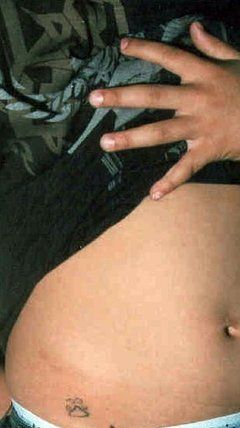
Fresno boy's tattoo

The boy shows his tattoo.

- Fresno Police

...

During preliminary hearing testimony Monday, Fresno County Superior Court Judge Hillary Chittick questioned whether a small tattoo is a permanent and painful disfigurement worthy of a potential life sentence that comes with a mayhem conviction, then asked to think it over.

The defendants were not charged with the one crime that defense attorneys agreed they deserved: applying a tattoo to a child under 18, which in California is a misdemeanor that carries a six-month sentence.

...

During questioning Monday of the boy's pediatrician, Nieto raised the issue of other painful and scaring [sic. scarring?] procedures to which parents subject their children, such as ear piercing and circumcision.

On Friday, Chittick, a former public defender, questioned Lacy over the legal definition of mayhem and whether a small tattoo, which is being removed, meets the test.

...

Outside the courtroom, Gorman's family was eager to tell their side of the story, which supported the defense contention that the boy asked his father for the tattoo, saying: "I want to be like you."

Gorman and Gonzalez are both members of the Fresno Bulldogs, a notorious street gang that has been the focus of intense police action for three years.

... In April, Gonzalez went to Gorman's house to have one applied to his chest and brought his son along.

"They didn't hold him down, he said he wanted it," said Meriah Ramirez, Gorman's girlfriend, who said she saw the encounter.

...

Earlier story


AP
October 2, 2009

NC dad sentenced to 150 days for circumcising son

A father who admitted he circumcised his infant son with a box cutter was convicted of misdemeanor child abuse and sentenced Friday to 150 days in prison.

Johnny Eric Marlowe, 33, will serve the sentence after serving time for previous crimes, The News-Topic of Lenior reported.

Marlowe had been charged with two felony counts of child abuse after prosecutors said he circumcised two newborn sons without anesthesia when each was just days old in 2005 and in 2006.

But the Caldwell County jury convicted Marlowe with a misdemeanor on one child abuse charge and deadlocked on the second, leading the judge to declare a mistrial on that charge.

Marlowe's ex-wife, Amber, asked Superior Court Judge Robert Ervin to impose the maximum possible sentence.

...

Amber Marlowe testified that one of the young boys bled for nearly 11 hours after Marlowe performed his circumcision. Marlowe admitted he had no formal training and gained most of his knowledge about the procedure from watching videos on the Internet.

...

Marlowe, who represented himself at the trial, filed a notice of appeal for Thursday's conviction.

...

Earlier story


Mystery? What mystery?

WABC News (includes video)
October 2, 2009

Baby death mystery

Bradley Dorcius

BROOKLYN (WABC) -- Shock and sorrow for a mother and father in Brooklyn.

They took their infant son to the hospital for what they thought was routine surgery.

Now, they're planning his funeral.

Seven-month-old Bradley Dorcius died two days after having an operation to correct his urine flow and a circumcision.

In the recovery room at SUNY Downstate Hospital, his mother says Bradley began bleeding from his mouth and nose, and later died.

[As did Amitai Moshe]

His parents are devastated and they're demanding answers.

The hospital spokesperson calls Bradley's death a sad incident and says the hospital is investigating. His parents say he had no allergies and no other known medical conditions.


Parents make many decisions for their children ...

Huffington Post
October 1, 2009

7-Year-Old Tattooed, Judge Considers Life Sentence For Father

FRESNO, Calif. — Enrique Gonzalez wanted his 7-year-old son to have a gang tattoo, like the many that adorn his own body. About that there is no dispute.

The question that a judge says she will decide Friday is whether placing a tattoo on a minor is a permanent and painful disfigurement worthy of the potential life sentence that comes with a mayhem conviction, or is it something less?

Are there other procedures children routinely undergo that are decidedly more painful and permanent?

The tattooing case became international news in April, not just for the quarter-size dog paw print on the right hip of the young boy, but for what the paw represented: Fresno's most notorious criminal street gang, the Bulldogs.

...

Law enforcement officials threw the book at Gonzalez and Gorman.

But testimony at the preliminary hearing this week to establish which charges the evidence supports gave pause to Fresno County Superior Court Judge Hillary Chittick.

A defense attorney, seeking to undermine the potential mayhem charge, raised the issue of a painful, irreversible, and increasingly controversial medical procedure with the boy's pediatrician, a witness for the prosecution.

"Which is more painful, circumcision or a tattoo?" asked public defender Manuel Nieto about the practice performed on a decreasing number of newborn boys.

"I would guess the circumcision," Dr. Carmela Sosa responded.

"Do you recommend it to your patients?"

"There may be medical reasons that develop, but not on a routine baby."

...

"It seems to the court," Judge Chittick said as she asked Monday for a few days to think, "that mayhem requires a certain level of bodily injury, and I'm not sure a quarter-sized tattoo meets that."

Disfigurement doesn't have to be permanent to qualify as mayhem, says law professor Laurie Levenson, director of the Center for Ethical Advocacy at Loyola Law School. Gonzalez could argue that he didn't intend to harm his son, she said, but that won't necessarily take the life sentence off the table either.

"It's an interesting issue," Levenson said. "I don't think kids belong to their parents. You can give a child the haircut you want him to have, but you can't permanently disfigure a child."

Gonzalez granted his son's request for the tattoo because the son begged "I want to be like you," the defense says. But the prosecution says Gonzalez held the boy down while Gorman forcibly applied it.

Either way, says Levenson, "I don't know if children can readily give permission for a tattoo." ...

(to the rest - if this link fails, contact us)

Earlier story

Back to the Intactivism index page.