| |
Circumcision - Miscellaneous
(When items in this section gather enough detail, they
will be moved to their own pages.)
The Shakespeareans
Many articles about circumcision in the mass media fall into two
classes,
- the Hamlets and
- the Caesars.
The Hamlets are typically called "To
Cut Or Not To Cut?" (cf Hamlet III, 1, 56) and often subtitled "The
Circumcision Decision". (Originality is not their strong point.) They
present circumcision as a decision parents must make, "after weighing
all the evidence". They then present all the medical
evidence for circumcision. They invariably mention
early on how ancient circumcision is, and sometimes quote the text of
the command to Abraham (Gen 17 10) in full - as though this has any
relevance to present-day gentile parents. If they mention objections,
it is dismissively. If they mention foreskin restoration, they stress
its outlandishness.
An observer comments:
|
"The apparently universal assumption that
circumcision is quite a reasonable choice seems to me analogous to:
- Wives: to beat or not to beat
- Feet: to bind
or not to bind
- Politicians: to lynch or not to lynch"
|
In other words, not all decisions that can be expressed
as "X or not X?" are evenly divided.
The Caesars are typically called "The
Most Unkindest Cut" (Julius Caesar III, 2, 188). They commonly begin
with parents agonising over whether to have their son circumcised.
(They almost invariably do. If parents who do not circumcise are
introduced, their reasons are diffidently expressed: "We just didn't
think it was necessary" and the like.) They are much more likely to
mention complications, the lack of support for circumcision by
professional bodies, and human rights issues - but not to analyse them
in any detail.
The July 2001 issue of (Australian) "Men's Health" has
an anomalous article, called "The Unkindest Cut?" but in every other
way a Hamlet. It draws extensively on physiology professor Brian Morris, who makes the absurd claim that foreskin restoration - not circumcision
- is genital mutilation.
Episodes of the TV Sitcoms "The Nanny" and "Off Centre"
have been called "The Unkindest Cut". Both were strongly
pro-circumcision.
Article in the
Oakland Tribune. "The unkindest cut? Many parents
disenchanted with circumcision", March 14, 2004 includes quotes from
both Marilyn Milos and Edgar Schoen
The Sydney Morning Herald for February 21, 2010 has an
article called "More boys go under knife as parents opt for
kind cut" which is wrong in almost every particular.
An article in Mother Jones,
March-April 2010, is called "Much Ado About
Cutting". (Since "Cutting" stands in for "Nothing", this might
trivialise the issue, but the article is quite balanced.)
Few articles condemn circumcision outright, or make
central the baby's human right to decide the fate of his own penis.
They might be classed as Banquos: "Too cruel any
where." (Macbeth II, 3, 95)
See also "How to write
about circumcision"
(In New Zealand, articles on circumcision also have a
theatrical bent: at least six have appeared using the title of Greg
McGee's hit play "Foreskin's
Lament" and have documented its decline over the last several
decades.)
Circumcision in Shakespeare
|
"There's a divinity that shapes our ends,
Rough-hew them how we will...." 
|
This section has been removed to The Stage.
The foreskin and circumcision in other
literature.
Balanitis and Diabetes
These pages until recently listed as one of the few
legitimate reasons for circumcising,
"As a treatement of last resort for chronic balanitis
(inflammation) due to diabetes"
A doctor recommends instead "topical antifungals and
better control of the diabetes."
And a diabetic writes "so long as I consume a lot of
real yoghourt, I can avoid Monistat Derm if I am careful with my intake
of sugar."
Another doctor writes:
It is probably not glucose in the urine of a diabetic which contributes
to the high incidence of balanitis, but rather the high tissue and
vascular glucose levels in the penis itself, like every other tissue in
the diabetic. Remember also that urine is generally sterile (not
infectious) whether or not it contains higher than normal levels of
glucose. Therefore, tight control of diabetes is the answer to
preventing balanitis and other infections which are found so commonly
in diabetics. And then the issue of circumcision for balanoposthitis
becomes moot. Truly the only people I have referred for circumcision (2
in the last 20 years) have been diabetics who have not taken care of
themselves (usually drinking too much alcohol concurrently) and for
whom no topical or anti-microbial therapy has given long-lasting cure
of their penile inflammations and infections.
Inflammation vs Infection
Inflammation:
<pathology> A localised protective response elicited by
injury or destruction of tissues, which serves to destroy, dilute or
wall off (sequester) both the injurious agent and the injured tissue.
It is characterised in the acute form by the classical signs of pain
(dolor), heat (calor), redness (rubor),
swelling (tumour) and loss of
function (functio laesa).
Histologically, it involves a complex series of events, including
dilatation of arterioles, capillaries and venules, with increased
permeability and blood flow, exudation of fluids, including plasma
proteins and leucocytic migration into the inflammatory focus. Origin:
L. Inflammatio, inflammare = to set on fire
Infection:
1. <microbiology> Invasion and multiplication of
microorganisms in body
tissues, which may be clinically unapparent or result in local cellular
injury due to competitive metabolism, toxins, intracellular replication
or
antigen antibody response. The infection may remain localised,
subclinical
and temporary if the body's defensive mechanisms are effective. A local
infection may persist and spread by extension to become an acute,
subacute
or chronic clinical infection or disease state. A local infection may
also
become systemic when the microorganisms gain access to the lymphatic or
vascular system.
Balanitis, posthitis, balanoposthitis, etc, are
inflammations,
not infections. The inflammation may be caused by a localized
infection,
or may be a reaction to a different irritant without infection.
An infection only exists when an abnormal microorganism
has been
identified as the cause of the problem, not merely through presence
(vast numbers of microorganisms normally live on our bodies). A
microorganism must be identified in order for an infection to be
declared.
If no microorganism is overabundant in the area, then
balanitis,
posthitis, or balanoposthitis are all simple inflammations which will
go
away soon after the removal of the the cause: manipulation, urine,
soap,
some tap water, lotions and moisturizers, creams (prescribed or over
the
counter), fabric softeners, detergents, body wash, cologne, etc).
By premature forcible manipulation of the foreskin,
tears can be made
which in themselves can cause inflammation. By allowing these tears to
heal, preventing further manipulation and not introducing other
agents, the inflammation will subside on its own.
Inflammation is a defensive action of the body.
Infection is an
invasion by a microorganism. They are two completely different things.
Either can occur without the other.
Permanent retraction
A significant number of intact men have their foreskins
permanently retracted. Especially if they began doing it in childhood,
the foreskin fails to grow.
- A New Zealand man was told by his mother that he must
keep it retracted at all times "or it might have to be cut off". (This
is apparently a misunderstanding of the instructions issued to the
nurses of the Plunket Society during the period 1917-1949 to ensure
that foreskins were fully retractable by a week after birth.) Faced
with such a threat, he naturally obeyed (and the psychological effect
of such a near-castration threat is unknown).
- This behaviour appears to be common in parts of
Japan, unknown in others.
- At least one Indonesian man used this means as a boy
to conceal his foreskin and escape circumcision. He was very pleased by
the effect of foreskin restoration,
which is even more pronounced here, where all the nerves of the ridged band are
retained, than where the foreskin has been surgically removed.
Do babies remember being circumcised?
|
... since infant circumcision occurs well and
truly before the onset of language acquisition, and before the cerebral
cortex matures sufficiently to have commenced functioning properly, it
is obvious that memory traces associated with the trauma of infant
circumcision involve more primitive parts of the human brain - eg.
brain stem and sub-cortical regions.
Classical conditioning of emotions is certainly
possible in these more primitive brain regions, so circumcision must
certainly have a profound effect on the baby's brain. No question -
especially if, like most circumcisions, it is performed "cold" without
any anaesthesia. Very traumatic for the child - no question!
But non-verbal, emotional memories cannot be
retrieved as words, so verbal reports (under hypnosis etc.) of being
able to consciously "remember" this trauma must be questionable. People
often fantasize, and conscious "memory" is easily distorted by later
intrusions - ask any good trial lawyer.
Having said all that, there still remains the
strong likelihood that infant circumcision trauma adversely affects a
person's emotional reactivity throughout his life.
- Gregory J. Boyle, Ph.D
Professor of Psychology
Bond University, Gold Coast
Queensland, Australia
|
|
Neuroscience has shown that the major brain
structures essential for
forming conscious (explicit) memories are not functional during the
first
two years of life, providing an elegant explanation of what Freud
called
infantile amnesia. As Freud surmised, it is not that we forget our
earliest memories; we simply cannot recall them to consciousness. But
this
inability does not preclude them from affecting adult feelings and
behavior. One would be hard-pressed to find a developmental
neurobiologist
who does not agree that early experiences, especially between mother
and
infant, influence the pattern of brain connections in ways that
fundamentally shape our future personality and mental health. Yet none
of
these experiences can be consciously remembered. It is becoming
increasingly clear that a good deal of our mental activity is
unconsciously motivated.
- "Freud Returns," by Mark
Solms
Scientific American, May 2004, p 85
|
Sickle-cell trait and magical mutilation
Sickle-cell trait is genetic, carried on the HbS gene.
Those with two of the genes (homozygous) suffer from sickle-cell
anaemia and only half survive to adulthood. Those with only one
(heterozygous) gain some protection from malaria. As a result, the gene
is common where malaria is prevalent. Among the Igbo tribes of Nigeria,
25% are carriers. The gene also also alters the shape of the skull and
may shorten fingers.
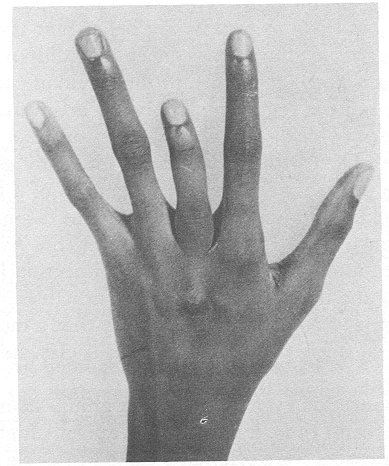 Children born with such traits may have another finger mutilated
to protect them against dying from the disease. It may be that
circumcision originated in a parallel, magical way.
Children born with such traits may have another finger mutilated
to protect them against dying from the disease. It may be that
circumcision originated in a parallel, magical way.
Male
nipple removal
Some African tribes cut male foreskins "to remove the
female element from the male". Here is another operation with
the same purpose:
"... ablation of the male nipple is
practised among, for example, the Djangero in the high valley of the
Omo Bottego in Western Ethiopia. According to Freud's disciple and
friend Marie Bonaparte, the French explorer of Ethiopia, Jules Borelli,
reported in 1888 that the custom was practised because 'a man should
not look like a woman.' Forty years later, in 1928, when Marie
Bonaparte visited the area, she was given the same justification for
the persistence of the rite."
|
Two other valuable organs once thought useless:
- The appendix
For a long time the human vermiform appendix was
thought to be a useless "vestigial" organ. It turns out the appendix
contains special "gut-associated lymphoid tissues".
"Thus ... a growing quantity of evidence indicates
that the appendix does in fact have significant function as part of the
body's immune system. The appendix may be particularly important early
in life because it achieves its highest state of development shortly
after birth and then regresses with age, eventually coming to resemble
such other regions of gut-associated lymphoid tissue as the Peyer's
patches in the small intestine. The immune response mediated by the
appendix may also relate to ulcerative colitis and other inflammatory
conditions."
- Scientific American, Nov
2001, p 84
People who have had their appendix removed are
more likely to develop the digestive disorder Crohn's disease,
results of a new study suggest.
"It's not clear if appendicitis increases the risk
of Crohn's disease, or if people at risk for Crohn's disease are more
likely to develop
appendicitis. However, the findings may help shed light on both
conditions," according to the lead author of the study, Dr. Roland E.
Andersson.
- Reuters
Health
But of course there's a third possibility: the
appendix performs some function that tends to prevent Crohn's disease.
For example:
|
Discover
January 15, 2008
And Here's Why You Have an Appendix:
When you're sick, it re-boots your
gut with good bacteria.
by Josie Glausiusz
In September, a team of surgeons and
immunologists at Duke University proposed a reason for the appendix,
declaring it a “safe house” for beneficial bacteria. Attached like a
little wiggly worm at the beginning of the large intestine, the 2- to
4-inch-long blind-ended tube seems to have no effect on digestion, so
biologists have long been stumped about its purpose. That is, until
biochemist and immunologist William Parker became interested in
biofilms, closely bound communities of bacteria. In the gut, biofilms
aid digestion, make vital nutrients, and crowd out harmful invaders.
Upon investigation, Parker and his colleagues found that in humans, the
greatest concentration of biofilms was in the appendix; in rats and
baboons, biofilms are concentrated in the cecum, a pouch that sits at
the same location.
The shape of the appendix is perfectly suited
as a sanctuary for bacteria: Its narrow opening prevents an influx of
the intestinal contents, and it’s situated inaccessibly outside the
main flow of the fecal stream. Parker suspects that it acts as a
reservoir of healthy, protective bacteria that can replenish the
intestine after a bacteria-depleting diarrheal illness like cholera.
Where such diseases are rampant, Parker says, “if you don’t have
something like the appendix to harbor safe bacteria, you have less of a
survival advantage.”
|
|
A useful appendix
Once thought of as a vestigial organ, the
appendix is filled with filmy life, consisting of billions or even
trillions of microbial cells. Bill Parker at Duke University Medical
Center in Durham, North Carolina, thinks he has figured out what it
does - or did, if you happen to have had yours removed. He sees the
appendix as an old-growth forest, containing all the species needed to
reseed the rest of the gut with beneficial microbes should the need
arise (Journal of Theoretical Biology, vol 249, p 826). lt is most
crucial when the natural flora in the rest of the gut is laid waste by
infections such as cholera - or, in the modern world, following overuse
of antibiotics.
- New Scientist,
December 3, 2011, p 53
|
- Jacobson's Organ
Jacobson's organ (the vomeronasal organ) is a tiny
sensory organ inside the nose near the nostrils, distinct from the
olfactory bulbs which detect the smells of which we are conscious. In
other mammals, Jacobson's organs detect pheromones (sexual
attractants). If the organ is removed from mice, guinea pigs or prarie
voles, they no longer display courtship or mating behaviour towards the
opposite sex, or fail to recognise their own offspring.
Like the appendix and the foreskin, Jacobson's organ
has commonly been removed in the belief that it has no function -
ironically, often in the course of rhinoplasty (nose-jobs), so an
operation intended to make someone more attractive may also make them
less attracted.
- from "Jacobson's Organ and the remarkable
nature of smell"
by Lyall Watson
Of course, it doesn't follow that every organ once
thought to be useless will turn out to have value, but they are other
examples of something doctors assumed could be removed with impunity.
Circumcision and royalty
The penile status of royalty seems to have an abiding
fascination for both circumcisors and Intactivists, as if they should
set some kind of example to us.
It is widely reported that Louis XVI of France could not
father children until he was circumcised. Unfortunately for the story,
he was already a father well before the alleged operation. Remondino
invented this lie in his history of circumcision. It served his need to
find historical precedent for circumcision in Europe, to make the
ritual seem less alien and more familiar. These were calculated lies
without any historical basis. A more scholarly study from France (Le
phimosis de Louis XVI (1754-1793) aurait-il été a l'origine de ses
difficultés sexuelles et de sa fecundité retardée? [Prog
Urol. 2002; 12(1):132-7] by G. Androutsos) thoroughly debunked this
myth.
It has recently (2013) become part of popular wisdom
that George I began Royal circumcision in England and even that he
"brought the custom from Hanover". There is no shadow of evidence that
it was ever the custom in Hanover. This seems to be a complete
fabrication by circumcision fetishists.
The claim is widespread that Queen Victoria ordered her
sons and their descendents circumcised because she was a "British
Israelite" who believed she and they were directly descended from King
David. It is further claimed that Prince Charles was circumcised by a
mohel.
This claim has been spread by anti-Semites, in order to
discredit the royal family, by Jews in order to give status to
circumcision, and by others in order to make it respectable. What truth
there is to it, if any, is shrouded in royal reticence. It is now
generally acknowledged that royalty sometimes make mistakes.
There is eyewitness evidence from his babyhood that Prince William is
intact. (The unlikely claim has also been made that Prince Charles had
Wills and Harry circumcised after their mother's death.)
There was widespread discussion around the time of the
birth of Prince George, about whether he would be circumcised, based on
the above stories, but this seems highly unlikely.
Robert Darby and John Cosijn have written a historical
paper, making the same points, The British Royal Family’s Circumcision
Tradition, in Sage Open journals, October 16, 2013
Sikhs and Intactness
The Sikh faith actively discourages all body
modification, even haircutting.
|
Questions and Answers
(about Sikhism by Jasprit Singh)
SELF-ACCEPTANCE (kesh, tattoos, body piercings...)
Self-acceptance is an integral part of the Sikh
faith. Guru Gobind Singh, when confronted with spineless men and women
of Indian society...people who blindly followed and bowed before
manmade laws, no matter how degrading...introduced the Kesh-Kangha
privilege: Kesh (or unshorn hair) as a symbol of acceptance of the
Creator's given form, and Kangha (or comb) to take care of the
Kesh...to keep it healthy and clean.
In most cultures body modifications such as haircuts (many jobs are
off-limits for men with kesh), circumcision, tattoos, etc., are
demanded to ensure conformity and order. So much so that in the 1960s
when the Hippie Movement started in America, men grew their hair long
and kept their beards as a symbol of rebellion. However, the Sikh
concepts of kesh-kangha is not a sign of rebellion...it is a sign of
acceptance of the Creator's gift and a nurturing of that gift.
Q: Why does Sikhism reject haircuts,
circumcision and other similar rituals that a large fraction of the
world's population practices? Do Sikhs consider these people sinners or
bad people?
A large part of the world's population does
participate in rituals such as shaving of hair, circumcision, body
piercing, etc. In this sense, Sikhs are in the minority. However, for a
Sikh, acceptance of Nature's beautiful body is an important component
of the Sikh value system. Acceptance of one's God-given physique
without "improving" it by razors and scissors is a first step in
accepting other laws, the foremost of which is becoming a universal
being. Sikhs view others who engage in such rituals as people who carry
unnecessary burdens in their lives; not as sinners or bad people.
Q: What does the Guru Granth Sahib say
about body modifications such as haircuts, circumcision, tattoos, body
piercings, etc.?
It is common for religion texts to provide very
detailed outlines of do's and don'ts. The Bibles (old and new) and the
Koran provide very detailed guidelines to their flock on daily living.
The Guru Granth Sahib refrains from doing this. The Guru only provides
us basic Universal principles (One God, Truth brings bliss, oneness of
the human race, etc.) and the path to reach Truth (by minimizing ego
and seeing oneself in everyone). In the Sikh "rahitnama" or code of
conduct, kesh is to be accepted as the Creator's gift and taken care of
with a kangha (comb). Acceptance of the Creator's given body is a
natural outcome of a lifestyle that is in conformity with the Guru's
teaching. Of course, this does not preclude the use of surgery or other
medical interventions when the body has become ill.
Q: I am a twelve year old boy. When I go
to the gym locker room I see that most of the other boys are
circumcised. I feel so different because I am not circumcised and I
keep my hair long. How should I get over these feelings of being
different?
According to Jewish and Islamic beliefs is the
duty of a good Jew or Mulsim to be circumcised. This practice spread in
North America and by the 1970s almost all American boys were routinely
circumcised. This practice is reversing, and fast. It is expected that
in another generation very few American boys will be circumcised (in
European countries, this practice is rare). In a way, the idea of
self-acceptance is spreading and more people are looking at male
circumcision as a barbaric practice. Respected child psychologists and
the American Association of Pediatrics are raising their concern
against this practice. Even Jewish groups are arguing for the
discontinuation of the practice of circumcision. So it is very likely
that the boys you see in the locker room are envious that your parents
did not circumcise you.
From Akal Sangat (www.akalsangat.com)
-
|
|
"Because of the love of woman, circumcision is
done; I don't believe in it, O Siblings of Destiny. If God wished me to
be a Muslim, it would be cut off by itself. If circumcision makes one a
Muslim, then what about a woman?"
- Siri
Guru Granth Sahib Ji, Ang 477
|
This site (About.com Sikhism) speaks more
strongly:
|
Sikhs do not believe in practice, or condone
circumcising infant, or adult, males or females.
Circumcision is irreversible genital mutilation of
either gender. Circumcision involves amputation of the most sensitive
areas of either male or female genital organs and is commonly performed
on helpless infants without anesthesia. ...
Sikhs do not practice or condone circumcision of
either gender during infancy, childhood, puberty, or adulthood. Sikhs
believe in the perfection of the Creator's creation. Therefore Sikhism
completely rejects the concept of gender mutilation by circumcision.
...
In addition to such consequences as infection and physical deformity
resulting in child bearing difficulties, *psychologists have determined
trauma of circumcision in both males and female, regardless of age, may
last throughout the entire life. Sikhism considers circumcision
performed on minors below the legal age of consent child abuse and a violation of civil rights.
Sikhs have traditionally acted to protect the
weak, innocent or oppressed and to defend the defenseless. In 1755,
Baba Deep Singh aided the rescue of 100 boys and 300 girls from forced
conversion by Islamic invaders which included circumcision and returned
the young ones to their families unmolested.
...
there is no prohibition against anyone who may have suffered previous
genital mutilation being initiated into the Sikh faith later in life.
...
No body piercing to accommodate jewelry, tattoo inklings, or other
mutilation is permitted. The code of conduct carefully outlines in
detail what is expected of Sikh parents regarding their infant children
and gives no instructions for circumcision rather admonishes parents
not to harm so much as a hair on the child's head.
The Sikh code of conduct also outlines carefully
in detail all matters concerning matrimony including conjugal
obligations and again no mention is made of circumcision, for either
gender, ...
...
First Guru Nanak and Bhagat Kabir both address circumcision as
abnormal, and Fifth Guru Arjun Dev refers to it as a meaningless ritual
in Sikhism's Holy Scripture, Guru Granth Sahib. Bhai Gur Das writes
that circumcision does not insure liberation in his Vaars. Tenth Guru
Gobind Singh states in Dasam Granth that establishing ritual
circumcision has not instilled anyone with the knowledge of the divine.
|
Hinduism and Circumcision
What is Hindusism?
C H A P T E R 44
Medical Ethics
HINDU MEDICINE, KNOWN AS AYURVEDA, the “Science of
life,” has a highly developed system of practical ethics derived from
the Hindu principles of nonhurtfulness, the sanctity of all life, the
existence of the soul separate from the body and a willingness to
accept life’s circumstances as defined by one’s karma and dharma.
In 1999, HINDUISM TODAY was approached by the Texas
Medical Association to help them revise and expand a book on medical
issues called Faith of Our Patients. ...
To respond to their request, we enlisted the help of
Swami Bua, Swami Satchidananda, Swami Ranganathananda of the
Ramakrishna Mission, Swami Chidanand Saraswati (Muniji), Swami
Omkarananda, Swami Pragyanand, Swami Tejomayananda of Chinmaya Mission,
Satguru Sivaya Subramuniyaswami and his successor, Satguru Bodhinatha
Veylanswami. We also consulted with Dr. Virender Sodhi, an ayurvedic
and allopathic doctor in Washington, and Cromwell Crawford of the
University of Hawaii, an Indian-born specialist in Hindu medical
ethics. ...
Fortunately, as pointed out by Professor Crawford, the
ancient codifiers of ayurveda, Sushruta and Charaka, carefully
considered and documented the ethics of their profession and its
various medical procedures. They did so within the context of a Hindu
view of man, which, as Swami Ranganathanananda put it, “is that his
essential, real nature is the atman or Self, which is immortal,
self-luminous, the source of all power, joy and glory. Everything that
helps in the manifestation of the divinity of the soul is beneficial
and moral, and everything that obstructs this inner unfoldment is
harmful and immoral.” ...
...
Matters of Birth
Hindus consider children a gift from God, and the conception,
development and birth of a child are sacred events, honored by a
ceremony, or samskara, marking these rites of passage. Today’s medical
technology has developed many means for conceiving children (and for
their disposal before birth). Hindus
have a general unwillingness to interfere with nature and
a special aversion to abortion, based on the belief in reincarnation
and the sanctity of marriage.
...
Circumcision
Hindus consider the practice
of circumcision for males unnecessary and do not practice it.
Doctors should be alerted to Hindu views on this often-standard
procedure. A circumcised Hindu boy could face ridicule and
discrimination. In rare ocassions, the procedure is required as a
medical necessity for an adult, but is kept secret.
Bahá´ís and circumcision
The Bahá´í faith was founded by Bahá´u´lláh (Mírzá
Husayn-`Alí Núrí) after a series of mystical experiences when he was
imprisoned in Iran in 1853 for his involvement with the Bábí faith.
Muslims regard both as heretical for believing in prophets after
Muhammad. An estimated 4,490,000 people were Bahá´ís in 1988.
circumcision
Male circumcision is a requirement of Jewish law, and has become a
universal Islamic practice.
Many Bahá´ís of Jewish or Muslim background continue the practice, but
it is neither encouraged nor forbidden in Bahá´í law.
- A Concise Encyclopedia of the
Bahá´í Faith
by Peter Smith (Oneworld, Oxford, 2000)
Sociobiology and circumcision
Circumcision as a meme These items
have been merged and moved to their
own page.
Darwin and circumcision
Circumcision is of interest in the study of human
variation because it is an artificial variation that has been carried
out for millenia. (The Jewish custom is the best documented, but other
groups have done so for as long).
Before evolution by mutation and natural selection was
fully understood, Jean-Baptiste Lamarck (1744-1829) proposed that
characteristics acquired during an individual organism's life are
transmitted to its offspring; so a blacksmith's son might be expected
to have brawny arms. It was supposed that doing so repeatedly,
generation after generation, would strenghten the effect.
This is a testable claim, and one test would be whether
Jews are more likely than gentiles to be born without foreskins.
Darwin was unaware of Mendelian genetics (because Gregor
Mendel was an obscure monk who had published his work in an obscure
journal) and of genes as units of inheritance, but he was well aware of
Lamark's theory and considered this question. He wrote:
With respect to Jews, I have been assured by three
medical men of the Jewish faith that circumcision, which has been
practised for so many ages, has produced no inherited effect.
Blumenbach, however, asserts57 that Jews are
often born in Germany in a condition rendering circumcision difficult,
so that a name is given them signifying "born circumcised;" and
Professor Preyer informs me that this is the case in Bonn, such
children being considered the special favourites of Jehovah. I have
also heard from Dr. A. Newman, of Guy's Hospital, of the grandson of a
circumcised Jew, the father not having been circumcised, in a similar
condition. But it is possible that all these cases may be accidental
coincidences, for Sir J. Paget has seen five sons of a lady and one son
of her sister with adherent prepuces; and one of these boys was
affected in a manner "which might be considered like that commonly
produced by circumcision;" yet there was no suspicion of Jewish blood
in the family of these two sisters. Circumcision is practised by
Mahomedans, but at a much later age than by Jews; and Dr. Riedel,
Assistant Resident in North Celebes, writes to me that the boys there
go naked until from six to ten years old; and he has observed that many
of them, though not all, have their prepuces much reduced in length,
and this he attributes to the inherited effects of the operation.
57 'Philosoph. Mag.' vol. iv., 1799, p. 5.
The Variation of Animals and Plants under
Domestication, vol 1, pp 467
Thus Darwin left the question open and "came out through
that same door where in [he] went".
Mithridatum
Never heard of mithridatum? Cheer up, you are not alone.
|
Marvellous mithridatum
IT BEGAN with a king, Mithridates VI, ruthless
ruler of the ancient
kingdom of Pontus on the southern shores of the Black Sea. ...
Like many powerful people of the time, Mithridates
was afraid of being
poisoned ...
Assassins could
choose from any number of deadly plants, with henbanes, hellebores and
hemlocks ...
venoms from local snakes, scorpions or spiders. The king's answer was
to create an antidote that
would protect him against them all. ...
the ultimate antidote included
extracts from around 50 plants, a legless lizard and musk from a
beaver's
scent glands, all mixed into a palatable paste with honey. ...
There were other
antidotes - known as theriacs - but Mithridates's theriac, or
mithridatum,
clearly outclassed all others. ...
the Emperor Nero ...
exhorted his physician Andromachus
to develop a still better theriac.
Andromachus added extra herbs, upped the opium
content and dropped the
lizard, opting instead for viper flesh - assuming that it must contain
something that protected the snake from its own venom. Andromachus's
mithridatum contained 64 ingredients and was much more than an
antidote,
he claimed. Not only did it "counteract
all poisons and bites of venomous
animals", it would also "relieve
all pain, weakness of the stomach,
asthma, difficulty of breathing, phthisis [tuberculosis], colic,
jaundice,
dropsy, weakness of sight, inflammation of the bladder and kidneys and
the
plague".
[Does
this sound familiar?]
A century after Nero, Andromachus's theriac
received the ultimate seal of
approval ...
Galenus, or Galen as we know him, declared Andromachus's formula
the best: "Whoever took a proper dose in the morning was ensured
against
poison throughout that day."
Word of the amazing remedy spread across Europe.
Soon it was regarded not
just as proof against poison but as a panacea, an
effective remedy for all
manner of illnesses, including the most feared disease of all, bubonic
plague. ...
In England,
theriac, or "treacle" as the English called it, was the best the plague
doctors had to offer, unrivalled as both
preventive and treatment, they maintained.
...
From Byzantium to Bologna and Padua to Paris, the manufacture of
theriac
became a public spectacle, with elaborate procedures and ceremonies
...
So much trouble, and for what? In 1745 William Heberden, a London
doctor,
wrote An Essay on Mithridatium and Theriaca ridiculing the remedy. It
did
little more than make a patient sweat,.he argued. By the end of the
century, theriac had been dropped from the London Pharmacopoeia,
although
versions remained in some European pharmacopoeias until the late 19th
century.
...
Stephanie Pain, New
Scientist, 26 January 2008
|
Speed the day when circumcision is obscure as
mithridatum!
The Day of Ashura
The Day of Ashura is on the 10th day of Muharram in the
Islamic calendar and marks the climax of the Mourning of Muharram.
It is commemorated by Shi'a Muslims as a day of mourning
for the martyrdom of Husayn ibn Ali, the grandson of Muhammad at the
Battle of Karbala on 10 Muharram in the year 61 AH (October 10, 680
CE).[1] According to Sunni Muslim tradition, Muhammad fasted on this
day and asked other people to fast.
In some Shi'a regions of Muslim countries such as
Afghanistan, Iran, Iraq, Turkey, Azerbaijan, Pakistan, Lebanon, and
Bahrain, the Commemoration of Husayn ibn Ali has become a national
holiday and most ethnic and religious communities participate in it.
Some Shi'ite men and boys slash themselves with chains (zanjeer)
or swords (talwar) and allow their blood to run
freely. Others consider that heretical.
(Adapted from Wikipedia)
Those who consider such commemorations should not be
done on non-consenting boys, and that boys should not be coerced into
doing them to themselves, need to consider whether infant circumcision
is any better.
Tongue-tie
Tongue-tie is a condition in which the lingual frenulum,
a band under the centreline of the tongue, linking it to the floor of
the mouth, is short, preventing the tongue from projecting beyond the
teeth. It can cause difficulty in establishing breastfeeding and,
later, speech impediment.
It is analogous to frenulum
breve in the penis. Like that condtion, it can be readily
corrected, when necessary, with a small nick - frenuloplasty.
Parents should not allow anyone to berate them with a
charge of hypocrisy if they leave their son's penis intact but have
this condition corrected. Tongue-tie is a minor abnormality that may
impair function. The surgery really is minor, and causes no known
impairment to any other function. Tongue-tie is in no way analogous to
possessing a foreskin, and correcting it in no way analogous to
circumcision.
The expression "tongue-tied" meaning too shy to speak,
is a metaphor for this condition.
Adapted with thanks from Life's a Salad Bar
|
|